Impact Location and Hand Shock
12/12/25
We all know when the ball hits the paddle's "sweet spot" sometimes recognzed as the center of percussion (COP). The ball flies off the paddle face with no annoying shock to the hand. The COP for a paddle typically located somewhere about 12" from the butt or 4" from the tip. We also know that impacts away from the COP generate uncomfortable, sometimes painful, shocks.
From Wikipedia: "The center of percussion is the point on an extended massive object attached to a pivot where a perpendicular impact will produce no reactive shock at the pivot."
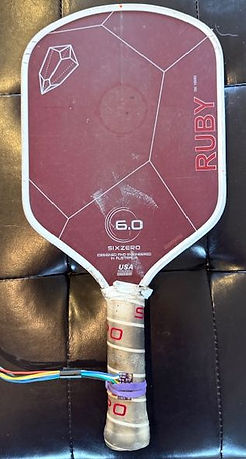
To visualize the forces experienced by the hand, a Ruby paddle has a 1/8" rod inserted 2 inches from the butt which is the standard hand-held pivot point. The rod is supported by two sticks that allow the paddle to freely rotate and translate. An impact hammer simulates the impact of a ball on the paddle face. (see the video) The impact hammer shoots a spring propelled mass at the paddle at a calibrated velocity with the energy similar to a 25 mph pickleball. A slow motion video at 154 frames per second is provided to visualize the impact and the resultant movement of both the paddle face and the handle (pivot point).


How does the paddle translate and rotate after an impact with the ball? What forces does the hand encounter? What happens when the ball impacts at the COP? Above the COP? Below the COP? Is the COP really the point of minimum vibration? Is it possible to capture what podcasters call the "feel" of the paddle (e g. hollow, dense, muted, poppy, etc.)
Balance Point and Center of Percussion locations are approximate and vary paddle to paddle
Visualizing the Impact Felt by the Hand/Wrist/Elbow
Center of Mass Impact
The simplest example of handle movement is one where there is little or no rotation involved - an impact near the center of mass (aka the balance point). The center of mass is typically located about 10" from the butt or 6" from the tip. As seen in the frame captures below the entire paddle quickly translates to the left while the paddle remains straight up and down (no rotation).
In actual court play, of course, the pivot cannot translate freely. It's being gripped by the hand. But the video allows us to visualize the force the hand/wrist/elbow must react to.
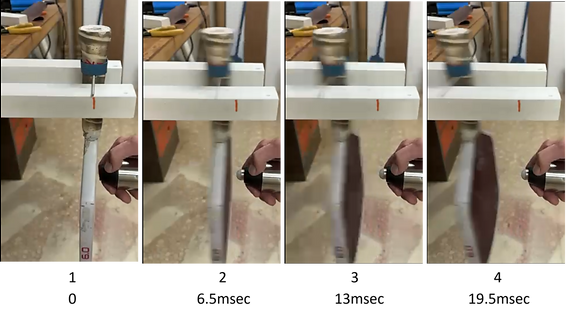
Frame 1 The paddle is static with the pivot point aligned with the orange marker.
Frame 2 The impact hammer piston has propelled the paddle left.
Frame 3 The paddle moves further left while the paddle remains upright (no rotation).
Frame 4 The paddle pivot point has moved about 3 inches in 19.5 msec or 8.7 mph
Center of Percussion Impact
The center of percussion impact is where there is little or no force exerted at the pivot point. The leftward movement (translation) and the clockwise rotation of the paddle perfectly counteract each other at the pivot. The impact is minimally felt by the hand. While the pivot point has negligible movement, the center of mass has moved 3 inches to the left in 19.5 msec like the example above! The paddle must obey Newton's second law.

Frame 1 The paddle is static.
Frame 2 The impact hammer has applied a 1 joule impact causing the paddle to translate and rotate around the center of mass. There is no movement at the pivot point.
Frame 3 & 4 The translation and rotation cancel at the pivot point leading to no movement
Impact Below Center of Percussion
In this scenario the rotational speed exceeds the translation speed at the pivot point. The pivot translates to the right during the first 19.5 msec as shown below. Even though the pivot point has moved to the right, the center of mass has moved 3 inches to the left in 19.5 msec like the examples above! The paddle must obey Newton's second law.
However, as shown in the sequence below, after 39 msec the pivot point,which had been moving right, reverses direction and begins moving leftward.
In actual court play, of course, the pivot cannot translate freely. It's being gripped by the hand. But the video allows us to visualize the force the hand/wrist/elbow must react to.


Frame 1 The paddle is static.
Frame 2 The impact hammer has applied a 1 joule impact causing the paddle to translate and rotate around the center of mass.
Frame 3 & 4 The pivot moves rightward.
Frame 1 The paddle is static.
Frames 2 The impact hammer has applied a 1 joule impact causing the paddle to translate and rotate around the center of mass.
Frame 3 & 4 The pivot point translates rightward.
Frames 5-8 The pivot point changes direction and translates leftward.
Measuring the Impact Force
To quantify the impact force experienced by the hand a lightweight accelerometer (ADXL375) is rubber banded to the handle at the pivot point (2" from the butt). Force readings are gathered by a high speed processor (Nano ESP32) at about 3.2KHz. The paddle is gripped and a force using an impact hammer is applied at various locations along the center line of the paddle face.
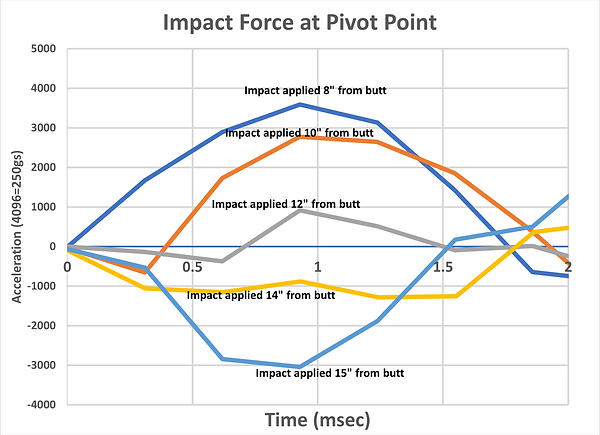
The graph below plots the first 2 milliseconds of the handle (pivot point) acceleration for impacts at different locations on the paddle face. During normal court play the ball is in contact with the paddle face only during those two milliseconds.
As demonstrated earlier in the frame captures, the handle moves in one direction for impacts above the center of percussion (COP); moves in the other direction for impacts below; and moves minimally for impacts at the COP. As would be expected the acceleration would be positive for impact locations less than 12" (the COP) and negative for impact locations more than 12".
The peak force is surprisingly high at about 250 gs (250 times the force of gravity).
Isn't a 250 G Force Dangerous?
We typically associate g (the force of gravity) with jet fighter pilots where blackout occurs during high speed accelerations of 5 gs. Or with major car crashes where deceleration of 70 gs are deadly. If we're experiencing a 250 g force with a hand held paddle shouldn't we expect broken bones? Well, from experience we know that doesn't happen. The damage caused by high g forces depends on the duration of the force. In pickleball, the duration of the force during a ball impact is short and the damage limited to minor discomfort.
From Wikipedia: The human body is flexible and deformable, particularly the softer tissues. A hard slap on the face may briefly impose hundreds of g locally but not produce any real damage; a constant 16 g for a minute, however, may be deadly.
The acceleration for a longer time period is graphed below. The behavior during the first 2 milliseconds is as expected - there is a positive pulse at the handle lasting about 2 msec for impacts above the center of gravity and negative below. This 2 msec pulse mimics the time the ball is in contact with the paddle. But after 2 msec the ball has left the paddle face and the force from the ball is gone. Why does the force at the handle reverse after 2 msec and continue oscillating? Shouldn't the force at the handle be zero after 2 msec?
All the analyses above use rigid body physics where the paddle is assumed to be a stiff body that has no internal vibrations. But the paddle is not rigid and instead flexes, bends and oscillates. There is a distinct oscillation at about 350 Hz that dies down after several tens of milliseconds. This is the first bending moment which can be likened to the paddle behaving like a diving board. The frequency is determined in large part by the stiffness of the paddle's neck. This oscillation causes an annoying buzz felt by the hands when striking the ball away from the sweet spot. This oscillation will be explored in depth in a future article.

Measuring Handle Displacement
Since the acceleration is know, it is easy to calculate the distance traveled by the handle in response to the impact. The paddle was gripped tightly in a [futile] attempt to keep the handle stationary. For impacts above the center of percussion (e.g. 8" from the butt) the handle moves continually in the same direction. The handle moved over 1.5 inches (~40 mm) before I could react (~150 msec) and return the paddle to the original position. The movement for impacts below the COP (e.g. 14" from the butt) starts out in one direction for a short time and then reverses direction.
One might ask, "Doesn't this large movement interfere with shot placement during competition?" The answer is no. The ball has left the paddle face after about 2 msec and the handle movement during that time is negligible (< 1mm).

Capturing the "Feel" of the Paddle
In theory, the forces measured by the accelerometer should reflect the forces felt by the hand and therefore should be able to distinguish between paddles with different feels (e.g. plush, stiff, hollow, poppy, boardy, harsh, connected, soft, etc). There are problems, though. What one person calls, for instance, "harsh" might not correspond with what another person calls "harsh". Even if we could agree on a definition, we're unsure what waveform difference is important. The magnitude of the shock? Frequency? Duration? Further, all the experimentation above was done with the sensor at the 2" pivot point. The 2" pivot point is popular because it's used in PEF and PBCOR paddle power measurements. However, the hand is in contact with the handle over a 3" to 5" length depending on the grip type and hand size. Where should the sensor[s] be located? Preliminary results find that the magnitude and frequency change depending on the sensor location. The "feel" of the paddle may by conflated with the sound of the paddle. Would the "feel" be the same when wearing noise cancelling headphones? There's lots of work to be done!
Summary
-
There is a force impulse transmitted to the handle by the impact of the ball. The force transmitted to the handle by a 25 mph ball is large (~250 gs) and short (1-2 milliseconds).
-
The force is directed at the base of the fingers if the ball strikes above the paddle's center of gravity (balance point).
-
The force is directed momentarily at the thumb if the ball strikes below the paddle's center of gravity (balance point) and then reverses and redirects the force to the base of the fingers.
-
The force in the hand is minimized when the ball strikes the center of percussion.
-
The force impact created by the ball also excites vibrations in the paddle that die out after a few tens of milliseconds. Under certain conditions (off-center hits; high ball speeds) the vibrations are large enough and long enough to create discomfort in the hands.
-
The force impact of a 25 mph ball is large enough to move the hand almost 2 inches. The force of a 50 mph ball would move the handle several inches.