The Sounds of Pickleball
4/17/26
We're all familiar with the sound made when the paddle strikes the ball. What bending and distortion of the paddle creates the sound? What frequencies are we hearing? How long does the sound last? What information can we glean from the sound? Power? Pop? Feel?

Sounds from three paddles. Selkirk Power Air Epic; Stock Pickleball Apes Pulse V; Core crushed Pulse V
Sounds from a Core Crushed Pickleball Apes Pulse V
To begin, let's examine what a microphone "hears" which is good representation of what we hear. A core crushed Pulse V paddle is struck by a screw driver handle 10" from the butt. The impact creates vibration in the paddle along with an audible sound. In general, the ball is in contact with the paddle face for only 1 to 3 milliseconds but the audible sound lasts longer than 50 msec.
The first 25 msec (0.025 seconds) of the audio waveform was captured by a high fidelity microphone and processed using Audacity. The waveform is pictured below. The 2 millisecond second impact is followed by a decaying waveform.

Audacity's Fast Fourier Transform (FFT) is used to extract the frequency content of he audible sound. Two prominent peaks are revealed. One is at 331 Hz and the other at 601 Hz. This is what we're hearing. Although there are other peaks present, they are 5 to 100 times "softer".

If the paddle is hit at 12" the frequency spectrum changes. See the picture below. The 601 Hz frequency is still prominent, but the amplitude of 331 Hz frequency has decreased by 12 db or 5 times softer. The amplitude of those two frequencies increase at some impact locations add decrease at others. This is why we hear a tonal change as the impact location changes.

The Logarithmic Axes
The Vertical Axis
The sounds we hear cover a wide range of "loudness" from the softest whisper to a rock concert to an explosion. To display such a wide range of loudness the Audacity program uses a logarithmic scale measured in decibels relative to full scale or dBFS. Google it for more detailed information. Most of us are more comfortable with a linear scale where we can easily visually judge the relative loudness of the two or three different frequencies that are of interest from a pickleball paddle.
The Horizontal Axis
the frequencies we hear cover a wide range from the bass of a pipe organ to a high pitch whistle. To display such a wide range of frequencies the Audacity program uses a logarithmic scale to cover the hearing range of 10 to 20,000 Hz. Most of us are more comfortable with a linear scale covering the 100 Hz to 2,000Hz range where the two or three different frequencies from a pickleball paddle lie.
Most readers will be more comfortable with a plot where both axes are linear rather than logarithmic. A linear plot of the first graph above is produced below.

Sound Origin
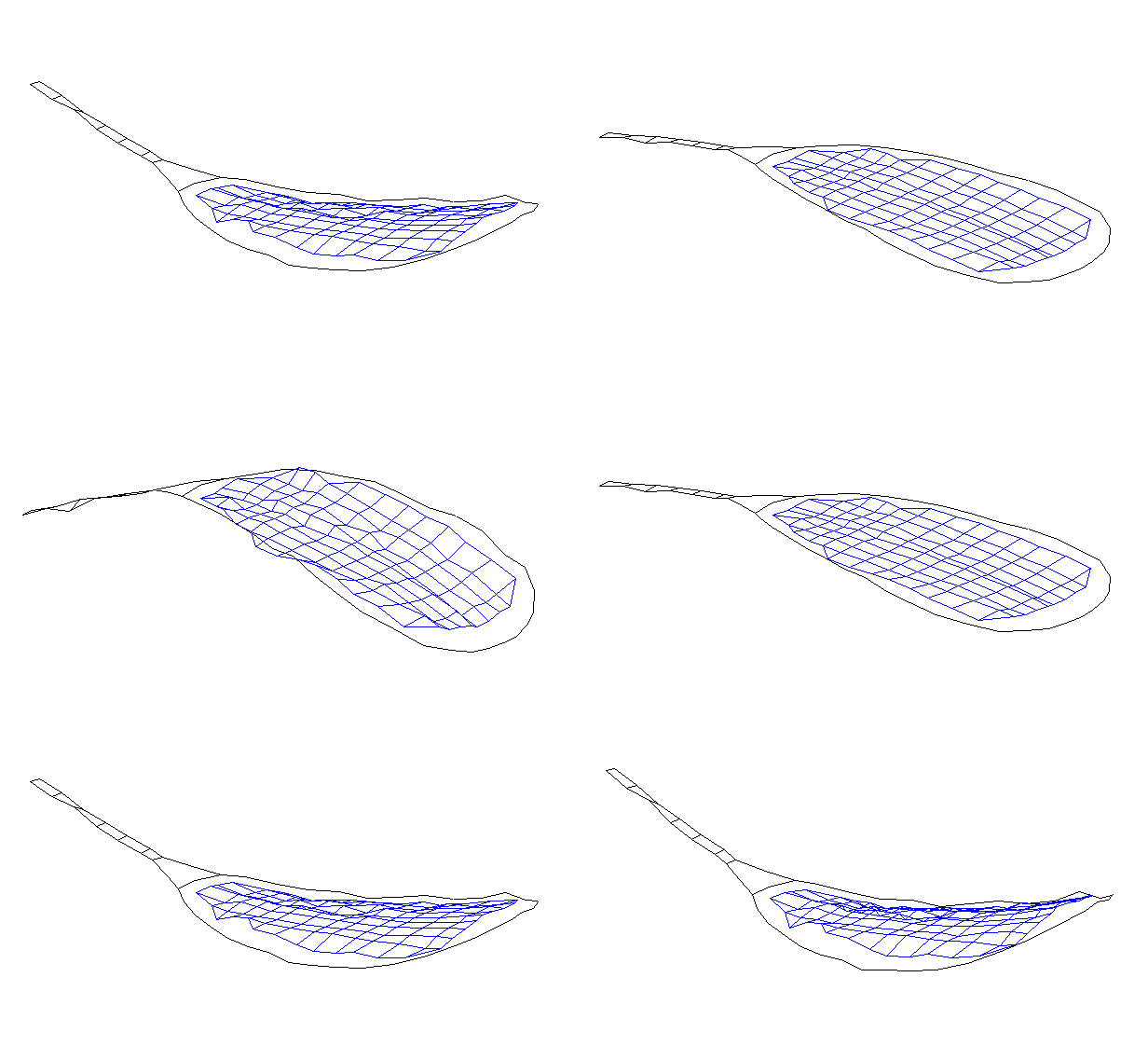
The paddle deforms when impacting the ball. There are a multitude of different bending shapes. The two most prominent are represented below for a racquetball racquet. The bending shapes are similar for a pickleball paddles.
The animation below reperesents the bending mode creating the 331 Hz frequency. The displacement at the tip of the paddle, the center of the paddle and the handle in the animation is exaggerated for clarity. The actual displacement during a 20 mph pickleball impact is less than 1 mm. The two "x"s represent nodes or points where there is no displacement. The face node is where where the ball should be contacted to minimize handle vibration and to minimize power being channeled into unproductive vibrations.
X
X
The animation below represents the paddle's membrane mode (aka trampoline mode) creating the 601 Hz frequency. The displacement at the center of the trampoline in the animation is exaggerated for clarity. The actual displacement during a 20 mph pickleball impact is less than 1 mm. There is an antinode at the center of the paddle face. The antinode is the impact location which excites the largest displacement and usually the location of maximum power.
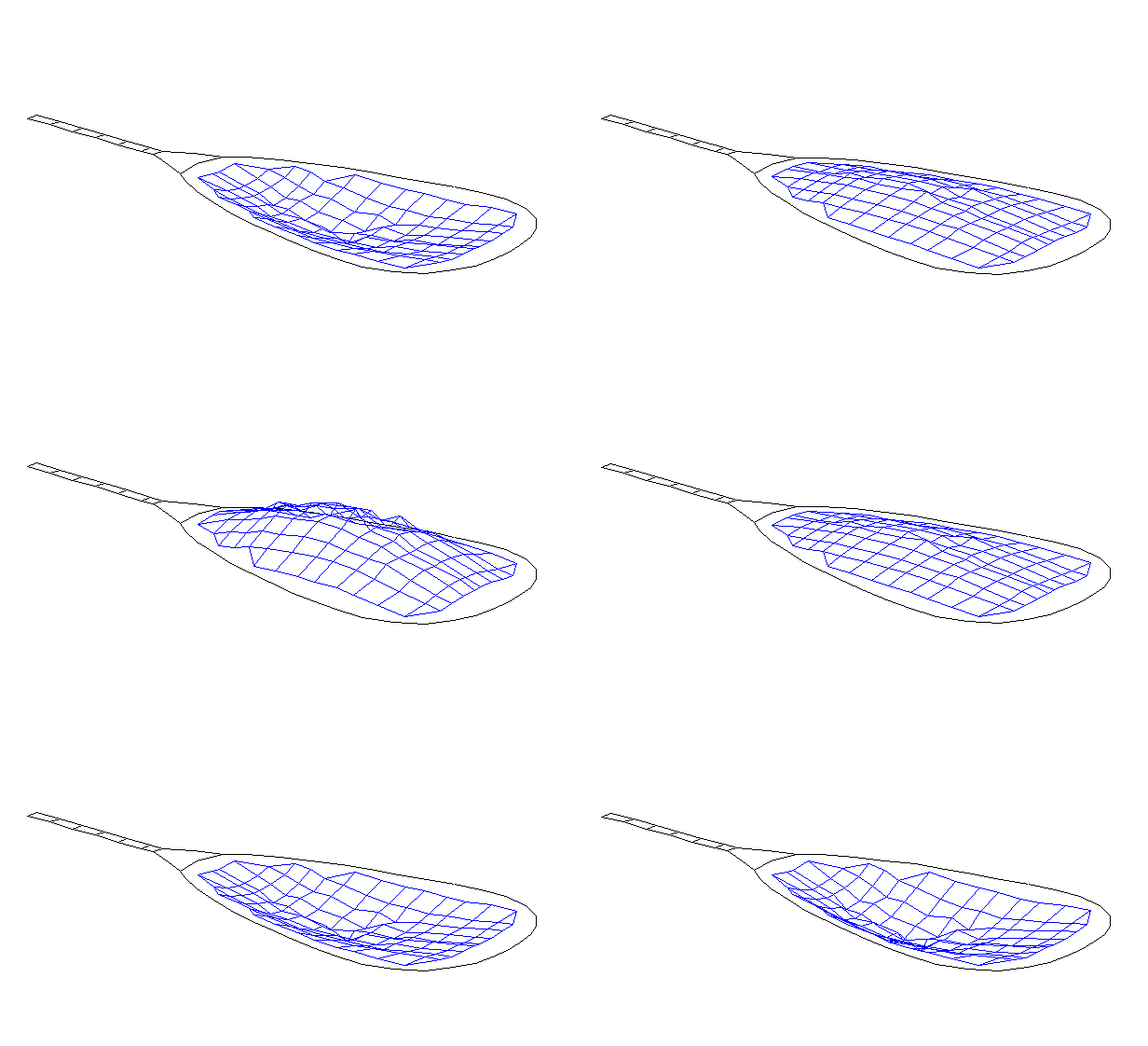
Both animations from Vibrational Mode Shapes of a Racquetball Racket
Another excellent animation of paddle vibrations can be seen at Pickleball Science
Sweet Spot
The graph plots the sound level of both vibration modes as a function of impact location. Note that the relative sound level of each mode changes with impact location creating different tones.
The bending mode is minimized when the impact location is at 12 inches (the node identified in the animation with an "X") meaning annoying vibration at the handle is minimized. At the same location the trampoline mode is maximized. It can be hypothesized that the trampoline mode at this point might "cup" the ball, increase the dwell time and increase the rebound speed. Further work is need to test this hypothesis. Coincidentally, 12" is the point of maximum PBCOR for this paddle.

Sounds from a Stock Pickleball Apes Pulse V
The sounds from a stock Pulse V consist of two prominent frequencies of 350 Hz and 681 Hz. These frequencies are a bit higher than the core crushed Pulse V. Normally, a core crushed paddle can be identified by its lower tone.

Sweet Spot
The graph plots the sound level of both vibration modes as a function of impact location. Note that the relative sound level of each mode changes with impact location creating different tones.
Like the core crushed Pulse V, the bending mode is minimized when the impact location is near 12 inches meaning annoying vibration at the handle is minimized. At the same location the trampoline mode is maximized. Twelve inches is the point of maximum PBCOR for this paddle.

Sounds from Selkirk Power Air Epic
The Power Air Epic is unique in that there is a "hole" in the throat. The Power Air Epic is also different from most current paddles in that does not have a stiff, thermoformed, carbon fiber frame. This probably why there are three prominent vibration frequencies. The 254 Hz frequency is the 1st bending mode. The 811 Hz frequency is, most likely, the 2nd bending mode. The 1223 Hz frequency is probably a membrane frequency. Further work is necessary.

Sweet Spot
The graph plots the sound level of the three vibration modes as a function of impact location. Note that the relative sound level of each mode changes with impact location creating different tones.
Like the core crushed Pulse V, the bending mode is minimized when the impact location is near 12 inches meaning annoying vibration at the handle is minimized. Eleven inches is the point of maximum PBCOR for this paddle.
