The "Feel" of the Paddle
6/4/26
YouTube reviewers describe the feel of a paddle by various terms - muted, plush, buttery, harsh, poppy, hollow, and responsive to name a few. Currently, there is no objective measure for any of these terms which leaves the viewer unable to understand what will be felt when the paddle is in their hands. There are specifications for paddle maneuverability - static weight and swing weight. There is a specification for paddle power - PBCOR. There is a specification for the ability of the paddle to resist twisting - twist weight. How about some specifications for paddle "feel"?
Johnkew has introduced the "feel wheel" to describe paddles in two dimensions as stiff/soft and dense/hollow. But his descriptions are subjective and other paddle reviewers place the same paddle in different locations on the "feel wheel". We need an objective measure of feel.
As documented in a previous article (The Sounds of Pickleball) each paddle produces two different prominent sounds when impacted by the ball. The bending mode frequency and the membrane mode frequency. The "feel" of a paddle is a combination of how the ear interprets those two sounds and how the hand feels those two vibrations.

Johnkew's Feel Wheel
Animations of the bending mode (left) and the membrane-trampoline mode (right) are displayed below. These excellent animations are from PickleballScience.


Building upon Johnkew's graphic, the horizontal axis is the auditory axis and the vertical axis is tactile axis.
The vertical tactile axis describes how the vibrations are felt by hand. Stiff denotes high intensity vibrations; soft denotes low intensity vibrations.
The horizontal auditory axis describes how the vibrations are interpreted by the ear. Low pitch sounds are hollow; high pitch sounds are dense.
The vibrations felt by the hand and the vibrations heard by the ear have been measured and analyzed in the time and frequency domain for multiple paddles to find the correlation with different "feel" terms such as stiff, hollow, dense and soft.
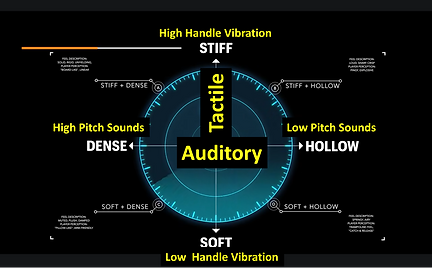
Johnkew's Feel Wheel with Axis Labels
The result is a map with defined axes and an ability to place paddles objectively.

Johnkew's Feel Wheel with Paddle Placement
Auditory Axis
Paddles typically have 2 dominant frequencies. The lower frequency is due to the bending of the paddle at the neck. The higher frequency is from the face acting like a trampoline. The 30 millisecond (0.030 second) time trace below is from a Ronbus Quanta R2 hit 14" from the butt (2" from the tip) as recorded by a microphone using Audacity.

A Fast Fourier Transform (FFT) displays the two prominent frequencies. Although the microphone "hears" the two frequencies at about the same loudness, most players would hear the 646 Hz vibration as much louder. The human ear is more sensitive to sounds as the frequency approaches 1,000 Hz. (for details Google equal loudness contours)

Different Sounds at Other Impact Locations
Different intensities of the 388 Hz and 646 Hz are excited at impact locations of 11", 12", 13" and 14".
At the 11" impact location (5" from the tip) the 388 Hz bending frequency is near a maximum (anti node) and the trampoline frequency is near a minimum (node). The player would most likely hear the 388 Hz tone.

The 12" impact location (4" from the tip) is getting near the "sweet spot". The trampoline mode is increasing and the bending mode is decreasing. The player would most likely hear the 646 Hz tone.

The 13" impact location (3" from the tip) is the point of minimum 388 Hz vibration. The 646 Hz trampoline mode is at a maximum (anti node). The player would hear the 646 Hz tone.

The 14" impact location (2" from the tip) is moving away from the "sweet spot". The trampoline mode decreases and the bending mode increases. The player would probably hear the 646 Hz tone.

Numerical Auditory Axis
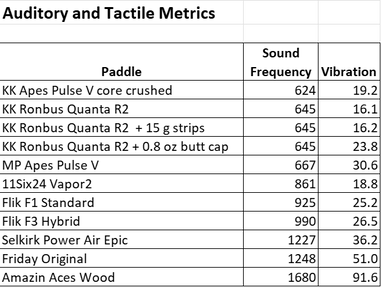
Most players contact the ball between 11" and 14" from the butt. The 11" to 13" impact locations are typically near the PBCOR maximum. The 14" location takes advantage of the higher rotational velocity as the impact moves further away from the pivot point. The dominant frequency at those impact locations is the membrane frequency. Thus, the membrane (trampoline) frequency becomes the auditory metric. Most membrane frequencies are in the 400 Hz to 1200 Hz region as seen in the table. The wooden paddle is an outlier at 1,680 Hz.

Enhance Turbo Paddle
I don't have the Enhance paddle. The membrane frequency was captured from a Youtube video where Johnkew was bouncing the ball off the paddle face.
The auditory axis of Johnkew's feel wheel can be described at one extreme to be hollow at 400 Hz and dense at 1200 Hz.

Tactile Axis
The tactile axis represents the vibrations felt be the hand. A 20 millisecond time trace from an accelerometer placed on the handle 3" from the butt is displayed below. The impact location is 14" from the butt or 2 " from the tip. The standard deviation over the first 20 milliseconds is 20.1 g (gravitational force) and is indicative of the intensity of the vibration.

The time traces of the 11", 12", 13" and 14" location is displayed below. As expected, the vibration is lowest at the 12" location which is near the center of percussion

The standard deviation at each impact location is listed in the table below along with the average.
Impact Location Standard Deviation
14" 20.1
13" 15.0
12" 11.9
11" 17.0
Average 16.1
Tactile Vibration Metric
The metric for paddle vibration is calculated as the average of the standard deviation at the four impact locations. The average vibration for various paddles is listed in the table. Most vibration metrics are in the 10 g to 50 g region as seen in the table. The wooden paddle is an outlier at 91.6 g.

The tactile axis of Johnkew's feel wheel can be described at one extreme to be soft at 10g and stiff at 50 g.

Combined Paddle Feel Metrics
The table lists the auditory and tactile metrics for several paddles.
Feel Map
Several paddles are plotted on the feel wheel.

Handle Design and Vibration
Most manufacturers take steps to isolate the handle from the frame surrounding the paddle face so as to minimize vibration. Some use soft foam pallets between the handle and the hand to dampen vibration. Some use soft foam between the frame and a molded handle to dampen vibration. Some truncate the frame so only a small length of the frame is in contact with the handle. The Friday Original paddle molded the entire length of the handle directly on top of the frame and, hence, the vibration is extremely high. Most likely this was one cost-saving factor that allowed the company to sell the paddle at the ground-breaking price of 2 for $100.
Equipment
The test set-up is pictured to the right. The paddle is hung from a beam with a flexible exercise band. The accelerometer is firmly pressed against the handle with a rubber band at 3" from the butt. The output of the accelerometer is captured at a 3.2 kHz rate by the ESP32 processor and later transferred to an Excel spreadsheet for further processing. The microphone is spaced 15 inches from the paddle face. The sound pressure is captured at a 44.1 kHz rate by the program Audacity. The impact hammer provides a repeatable one joule impact to the paddle face.
Microphone: Fifine K688
Accelerometer: ADXL375 +/- 200g
Processor: Nano ESP 32
Impact Hammer: IK06 1 joule
Why Position the Accelerometer at the 3" point?
The 3" location is approximately where the index finger is located and is arguably the location most sensitive to vibration.
Why Use an Exercise Band?
Why not use a rotating clamp at the 2" location just like in PBCOR testing? The PBCOR test has different requirements. For the PBCOR equation to work, all the momentum imparted to the paddle after the collision with the ball has to be channeled into rotational momentum. There can be no translational momentum. The PBCOR clamp eliminates any vibration at the 2" location and distorts the vibration at other points on the handle.
Isn't the Hand Just Like a PBCOR Clamp?
No matter how hard the paddle is gripped, the hand cannot approach the clamping force of the PBCOR clamp. The hand is more like a hard sponge rather than a massive metal PBCOR clamp.
When Testing Why not Grip the Handle as in Normal Play?
The harder the grip the more the vibration is dampened. It's difficult to replicate the clamping force from impact to impact and as a result the vibration measurements are not repeatable.
Why Use an Impact Hammer?
The force imparted by the impact hammer is repeatable. Also, the desired impact location on the paddle face is easy to target.
